
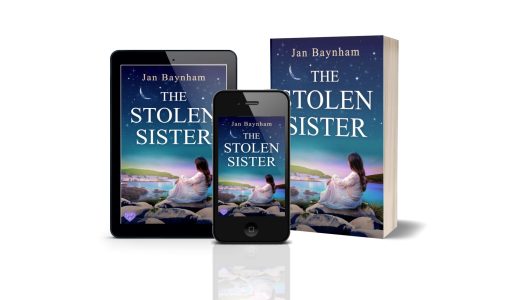
I’m delighted to be welcoming Jan Baynham whose sixth book – The Stolen Sister set in Crete was published recently, back to my blog today.

After retiring from a career in teaching and advisory education, Jan joined a small writing group in a local library where she wrote her first piece of fiction. From then on, she was hooked! She soon went on to take a writing class at the local university and began to submit short stories for publication to a wider audience. Her stories and flash fiction pieces have been longlisted and shortlisted in competitions, and several appear in anthologies both online and in print. In October 2019, her first collection of stories was published. Her stories started getting longer and longer so that, following a novel writing course, she began to write her first full-length novel. She loves being able to explore her characters in further depth and delve into their stories. Originally from mid-Wales, Jan lives in Radyr, Cardiff with her husband.
Welcome Jan, and thanks for joining me today to talk about your sixth book, which is once again set in another great location – Crete. Before we start, can I interest you in a Greek coffee and a slice of portokalópita. I love making it, but spoiler alert, always use ready-made filo pastry.
Thank you so much for inviting me back onto your lovely blog, Anni. And yes, please, I’d love a Greek coffee and a slice of orangey portokalópita. It’s one of my favourite Greek desserts. Ready-made filo is fine!
Congratulations on the release of The Stolen Sister, your sixth book.

Crete, 1963. Young artist Greta Ellis arrives at the sun-soaked port of Fáros Limáni, ready to paint and explore the beautiful Greek island.
There she meets passionate local, Andreas Papadakis, and Greta is swept up in a world of colour, freedom and forbidden love. But when tragedy strikes, Greta is forced to make an impossible choice that will change the course of her life — and her heart — forever.
Wales, 1984. After the death of her beloved mother Greta, silversmith Zoë Carter receives a sealed letter that upends everything she thought she knew. Greta’s dying wish is for her ashes to be scattered in Crete, a place precious to her . . . but somewhere she had never spoken of.
Searching through her mother’s belongings, Zoë uncovers a series of letters. Written in Greek and dated the year before she was born, they reveal a passionate love affair. And a tragedy that tore it apart.
Determined to know the truth, Zoë travels to Crete to follow the trail left behind in her mother’s letters. Through the olive groves and whitewashed villages of Crete, she begins to piece together a story of love, betrayal and loss — and discovers that her family was never what it seemed.
I’ve read all your books, and know that you are the master of dual timeline, this novel moves seamlessly between the 1963 and 1984, what challenges and opportunities do you find a dual timeline presents you as a writer?
Fascinated by family secrets where what happens in one generation impacts on the lives of the next, I always write two stories to reflect that. When I started writing dual timelines, I found it difficult to decide when to switch the timelines and keep up the pace of the story. Rather than interweave the two stories, chapter by chapter, as many dual timelines do, I resolved it by starting with a prologue that hints at something happening in one timeline and then tell each of the stories in larger chunks. This allows the reader to get fully immersed in what is happening to each character. I hope it works!
I don’t want to give anything away, but have to ask, what first sparked the idea for The Stolen Sister?
The Stolen Sister was inspired by a true story I read on a blog. A young American woman travelled to the island of Crete to find answers as to why her mother would never talk about the road accident that killed her father. Her mother shut out the memories, wanting her daughter to suppress them too. When she arrives in Chania as an adult, memories of that awful night start to come back to her. She reads a newspaper article detailing the accident and eventually finds her father’s grave to pay her respects. The ‘what if’s?’ started. What if a young Welsh girl knew nothing about her mother spending time in Crete? What if her mother’s request to scatter her ashes into the sea there was part of a secret she’d kept for over twenty years?

Crete plays a vivid role in this novel. What drew you to set the story there?
Crete is a favourite holiday destination, having visited the island many times, and I’ve always wanted to set a novel there. The fact that the blog post involved Crete also inspired me to set it there.
I know that you visited Crete, but what kind of research did you do into Crete during the 1960s and 1980s to help make this book feel more authentic?
As well as my knowledge of the island from holidays, I researched Crete and the Chania area in both eras as much as I could by reading books and articles online as well as watching videos. I made a research trip there last year and this proved to be invaluable. Finding out about the maternity clinics of the sixties from one woman’s first-hand experience and visiting the hippie caves in Matala are two examples.

The book is set within an artist community. What inspired you to explore this creative world? Do you paint? Silversmith?
I seem to have artist characters in several of my novels. I studied art in college and love the fact that an artist’s work can convey so much more than merely the colours or brush marks on a page or canvas. Creating a commune where a number of artists working and living together in a creative environment appealed to me. Yes, I do paint but hardly ever these days and not very well. I specialised in pottery and ceramics instead. I have no experience of silversmithing but wanted another craft for Zoë to pursue other than be a painter like her parents.
Zoë’s mother was a successful painter but suffered from postnatal depression. How important was it for you to explore the emotional impact of this?
Post-natal depression is something that many readers may have experienced. To me writing about it and how it affected Greta was a way of making her a real person rather than giving her an idyllic birth with a perfect baby that not every woman has. The fact that she learns to love Zoë unconditionally was important, too.
Was there a particular scene in The Stolen Sister you found especially emotional or challenging to write?
There are several scenes when I reached for the tissues as I was writing them. For me, however, the most emotional scene was when Zoë does what her mother asked of her, to scatter her ashes off the coast of Crete. Zoë was crying, I was crying and I suspect the readers will have a lump in their throats, too.
This is your sixth novel. How would you say your writing process has evolved since your first book?
When I wrote my first novel, I submitted to various publishers, keen to get a contract. As I got closer to fulfilling my dream, the rejections began to come back with feedback which I was able to act upon. The final draft had therefore been changed and worked on by myself and self-edited. Although I still self-edit, drafting and redrafting to get the submission to my editor as polished as I can make it, now it’s the Joffe editor, copy editor, line editor and proofreader who finalise the book before it’s published. I’ve always plotted the stories but now I write a detailed outline of the novel as a pitch to my editor and I use that as my detail plan.
Can you talk about your next novel and any future plans?
I’ve started writing my seventh book. It has a working title of Ginny’s Dilemma as my main character, Virginia Bevan, is faced with an impossible choice. Like my other novels, it’s another dual-timeline, dual-narrative emotional character driven story. Set in 1943 and 2000, in rural mid-Wales and Rethymnon, Crete, the story involves secrets, a tragic love-story, courage, duty and personal sacrifice. There is a sub-plot of misogyny and the underestimation of women together with the dilemma of choosing between maternal love and duty to one’s country. Ginny is an SOE working alongside the Greek Resistance on the island. Fifty-three years later, her granddaughter Chloe finds out about her grandmother’s life as a secret agent and helps Ginny resolve her guilt before it’s too late.
And finally, a question another writer asked me last year, was what was on my vision board for 2026? So, I thought it would be fun to ask all my guests this year if they would share one item on their board for 2026 – I might come back to you to later in the year and ask whether you achieved it! So, what would be one item on yours?
This year, I would like to read more…and not just in bed before I go to sleep every night as I do now but to settle down with a cup of tea, sitting in a chair! I like the concept of making a personal ‘library time’ each day to read paperback books. We are fortunate to have a lovely summer house that catches the afternoon sun so weather permitting in the months ahead, I know the exact chair.
Thank you for talking to me today, Jan, and good luck with this book. Anni x
Thank you for inviting me back onto your lovely blog, Anni. I’ve very much enjoyed answering your questions.
Book lInk:
The Stolen Sister: https://www.amazon.co.uk/Stolen-Sister-powerful-emotional-historical-ebook/dp/B0GN9Z34YH?ref_
Social Media Links:
Facebook – Jan Baynham Writer (https://www.facebook.com/JanBayLit/?locale=en_GB)
Instagram – janbaynham (https://www.instagram.com/janbaynham/?hl=en-gb)
Blog – Jan’s Journey into Writing (https://janbaynham.blogspot.com)
Anni Rose’s six uplifting and heartfelt romantic comedies are now available from Amazon in one box set:
